You can find the Exterior angle in a regular polygon by using Ratio Grids if you want to.

You can find the Exterior angle in a regular polygon by using Ratio Grids if you want to.
If you are not already confident using RATIO GRIDS then watch this video first!
What is 35% of £14?
What is 15% of £85?
My savings target is £5500. I have saved £2640. What percentage have I saved?
Jo scored 65% in a test. She scored 26 marks. What was the test marked out of?
A tree was 15m tall in January. Now it is 18m tall. What is the percentage increase in height?
Another tree has grown 15% since January. It is now 46m high. What was its height in January?
Now try some problems yourself:

Check out the Introduction to Ratio Grids if you are not already an expert!
When you are asked to do a currency conversion, you will usually be given an exchange rate first, as in this question:
Draw a simple Ratio Grid and give headings of £ and €. Put the numbers 1 and 1.18 in the correct columns. Then, the final number from the question, £350, goes in the £ column under the 1. Putting the numbers into their correct places is easy if you have headings! Put a ring around the empty space – that is where your answer will go.

In this grid, the 2 multiplying numbers are the “1.18” and the “350”, and you will divide by 1. So the sum will be 1.18×350÷1.
The answer is 413, and it is clearly in the Euros column, so give your answer as €413.
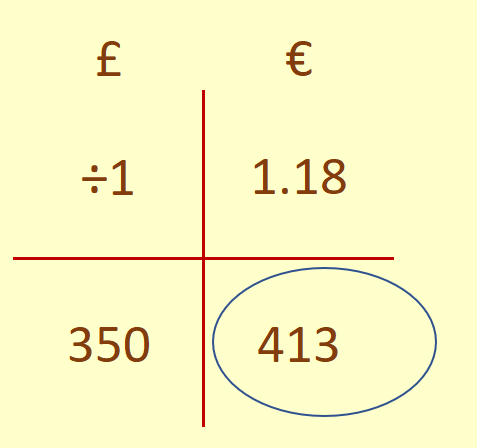
It’s easy if you get the headings right!
If you want lots of practice, Mr Corbett has a great set of currency conversion questions.
For lots of simple questions click here and the answers are here
Exam-style questions are here** and the answers are here. (Mr Corbett doesn’t use Ratio Grids so his methods won’t look the same, but the answers are all the same, obviously!)
** Some of these questions are really challening – they may require 2 ratio grids, so think carefully! If an exchange rate changes, you will need a new grid for the new rate.
Ratio Grids can be used whenever you have a problem that starts with 3 numbers, and you have to times and divide. They are a clear way of laying out your working, and knowing which order to do the calculation.
You will need a calculator to do the practice questions, but first, here is a video:
Your comments are very welcome – please use the box below.
Now you can use Ratio Grids to solve a Maths Problems, here are some types of problem you can try:
Rosalind very kindly agreed to work with my son, who was much younger than her usual age group. He was really struggling with KS1 maths, and was developing a fear of numbers which for a boy who was ahead of his peer group in all other subjects was causing him some confidence issues. Rosalind thought outside of her usual comfort box of teaching tools and adapted her reliable tried and tested teaching methods, for her younger audience – the result was fun! A whole host of maths games that my son really enjoyed and actually asked to play at home. These games helped him to gain confidence with numbers and combatted his fears. The result was a happy son, who by the end of KS2 was a strong all round learner who passed the grammar examination and obtained a place at Grammar School. We thoroughly recommend Rosalind as a tutor, and as my son approaches the commencement of his KS4 GCSE courses and now that Rosalind has returned from her sabbatical, we will definitely be seeking her additional support for revision and maths resilience.
My daughter was coached by Rosalind for five years from Y7 through to the end of Y11. When she started her confidence and self belief were low. Through her innovative approach to teaching, Rosalind built her self confidence and caused her to fall in love with Maths. She was more than a tutor, acting as a learning mentor which helped boost her confidence in all areas of the curriculum. My daughter went on to achieve a level 9 at GCSE Maths and A* in Maths and Further Maths at A level. She is now studying at Cambridge.
Dominic
My son was really struggling with maths at secondary school. Rosalind helped him to get through the GCSE curriculum but more importantly to grow in confidence and in his decision making so he could relax enough in his school lessons to be able to take in information without going into panic! Rosalind managed to get the best out of him and he was really engaged and liked going to his lessons.
Steph
With maths GCSEs looming, my daughter had an incredibly intelligent maths teacher who couldn’t communicate the subject. She was getting more lost each session and I looked around for a maths tutor and found Rosalind. Ellie was into dance and music and Rosalind somehow managed to make a connection with Ellie and related maths to pattern and rhythm of the numbers….. She loved going each week and managed to get a B grade at GCSE which given she was so behind was amazing. Thank you Rosalind!
Steph
Rosalind has been such an amazing tutor to me – I would never got my GCSE maths grade without her! I definitely recommend Rosalind’s teaching to anyone who is finding maths difficult, or is struggling with their confidence. She is so patient and thorough, and takes the time to make sure you fully understand everything. She even manages to make algebra fun! Thank you so much Rosalind, you are an excellent tutor!
Ellie
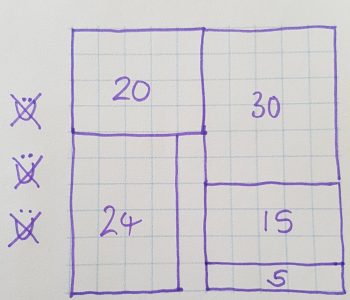
If you know a student has rather problematic times tables, and/or is not confident working with areas, then this game will help you to assess what the scope and nature of the problem is. Please read the notes about what to say before each round – if you “teach” all the strategies in advance, the game won’t be fun any more!
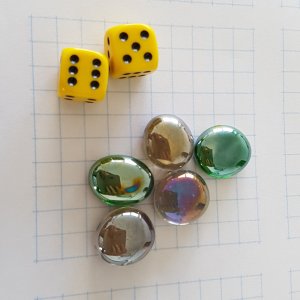 3 or 4 sheets of printed hundred squares
“Here is your new game board – by the way how many small squares is it made up of?”
Most will count the first row with their finger. If they do it without a finger, they may get to 9 or 11. If that does happen, I suggest saying “oops, I think you need to check that”. Wait until they have “10”.
Do they then count the number of rows next? Or count each square in the next row? Or count down the rows saying 10, 20, 30?
Wait until they have 100.
“So the maximum score for you will be 100.”
This step will tell you what strategy your pupil is comfortable using to find areas.
“Shall I start so you know what to do when it’s your turn?”. (This avoids the need for too many words!).
“Throw the dice, and use the 2 numbers to draw a rectangle. I’ve thrown 4 and 5. 4 and a 5 give you a 4×5 rectangle. Your score would be 20 for that, because it has 20 squares inside. That’s the area of the rectangle.” (You’ve explained it without putting them on a back foot by asking them for any of the information. You are only telling them how to play, not how to win.
Take turns to throw 2 dice and draw a rectangle. If a dice goes on the floor, say “Oh, it doesn’t count if it goes on the floor. You’ll have to roll it again”. This keeps the game calm!
How do they find the areas? Always count? Count correctly? Make mistakes with counting? Sometimes say “5,10,15,20”, sometimes say “5 5s are 25”?
This observation is *key* to what they may learn today. Choose the lowest level of skill (if they can’t confidently count, don’t worry about tables!!).
You should model at and just above their secure level of skill.
- They count badly? You use dots.
- They count well in ones? You count in 2s and 3s
- They know some of the tables facts? You use others
- They look up some facts on their chart? You look up all of them to reinforce this is a good strategy.
Once one of you has “blocked” most of the board, you will both need to draw 3 lives and each time you have a dice throw you cannot draw, you will lose a life. Once you are dead, the other player continues until they are dead.
Once both are dead, total up the scores you each have.
As they add their score, notice how they do it? Are they correct? Do they want you to do it? Can they add the numbers silently in their head? Do they want to jot the sum? do they want a calculator?
If they struggle and are unhappy, be helpful. Addition can be worked on with a different game on another occasion.
Did they sensibly squeeze the rectangles onto the board? Or spread them out and waste space? Are they ready for a “nudge” on strategy, and start being more efficient? Or are they still overwhelmed by the skills needed for this game?
If you decide to nudge, give specific advice like “why not draw this one in the corner here, to leave room for big ones later?”. This is simpler than trying to explain in an abstract way.
If you decide not to nudge, then aim to lose by spreading your rectangles out. if they make a comment, you can say “I’m trying a different approach this time to see what happens”.
Aim for an understanding of some strategies work better than others rather than one being more “right” or “clever” than another.
The winner of each round gets a counter. Play best of 5 games.
If this whole game is too easy, then draw triangles instead. These may be all right angled or for very advanced version, allow scalene triangles. Discuss areas in either case. Use a ruler!


 Bellropespider