Category Archives: Games

Maths Games mostly for 2-4 players

Brilliant (free) Factors and Multiples game on NRICH website

I am having a bit of a craze on Factors at the moment. I searched the web for “Fun with Factors” and came across this brilliant and very simple game on the NRICH website.**

There’s a neat online version or you can play a pen and paper version. I am likely to spend a while playing the online version today! What’s the longest chain you can make? I managed 18.

If you are aiming for a depth of understanding of Factors, then play as many games as possible – this is a really simple game for 2+ players that just needs 2 dice and a CASIO scientific calculator.

If you know another great factorising game, put it in the comments below!

**The game works brilliantly on a laptop but not so strong on an android phone.

Game of Rectangles


If you know a student has rather problematic times tables, and/or is not confident working with areas, then this game will help you to assess what the scope and nature of the problem is. Please read the notes about what to say before each round – if you “teach” all the strategies in advance, the game won’t be fun any more!

You Will Need
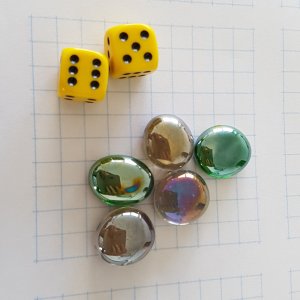
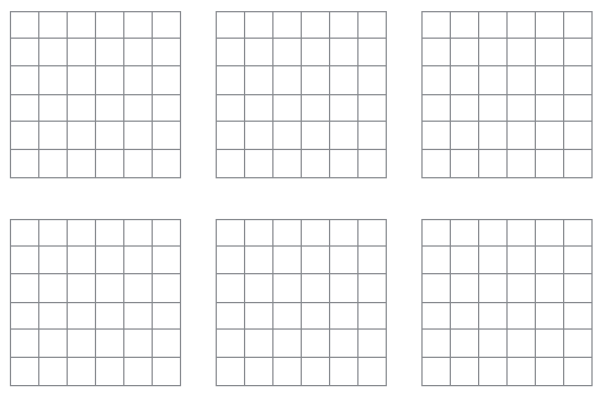
  • 20180731_1125385404856147751014693.jpg3 or 4 sheets of printed hundred squares
  • a pen each
  • 2 dice (or even better, 2 each)
  • 5 reward counters (coins? buttons? toy dogs? be imaginative)
  • A page of pre-printed tables in the student’s favourite layout.

Before you start

“Here is your new game board – by the way how many small squares is it made up of?”

Most will count the first row with their finger. If they do it without a finger, they may get to 9 or 11. If that does happen, I suggest saying “oops, I think you need to check that”. Wait until they have “10”.

Do they then count the number of rows next? Or count each square in the next row? Or count down the rows saying 10, 20, 30?

Wait until they have 100.

“So the maximum score for you will be 100.”

This step will tell you what strategy your pupil is comfortable using to find areas.

  1. If they counted all the squares from one to 100, then they still need practice doing that, and they will be doing so for the rest of the game. Concentrate on accurate strategies for counting, and celebrating correct answers. Using a pen to “dot” each counted square is usually enough. Confirming that the answers at the end of each row are 10,20,30 will avoid some of the errors.
  2. Most students can chant “10,20,30” and will be confident to do so for this task.
  3. If they count to 10 then count 10 rows and say “100”, they are demonstating that they are confident with the link between areas, repeated counting, and tables.

Round 1

“Shall I start so you know what to do when it’s your turn?”. (This avoids the need for too many words!).
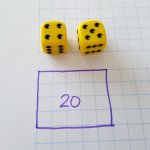
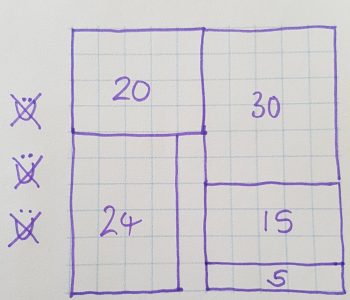
“Throw the dice, and use the 2 numbers to draw a rectangle. I’ve thrown 4 and 5. 4 and a 5 give you a 4×5 rectangle. Your score would be 20 for that, because it has 20 squares inside. That’s the area of the rectangle.” (You’ve explained it without putting them on a back foot by asking them for any of the information. You are only telling them how to play, not how to win.

Take turns to throw 2 dice and draw a rectangle. If a dice goes on the floor, say “Oh, it doesn’t count if it goes on the floor. You’ll have to roll it again”. This keeps the game calm!

How do they find the areas? Always count? Count correctly? Make mistakes with counting? Sometimes say “5,10,15,20”, sometimes say “5 5s are 25”?

This observation is *key* to what they may learn today. Choose the lowest level of skill (if they can’t confidently count, don’t worry about tables!!).

You should model at and just above their secure level of skill.

  • They count badly? You use dots.
  • They count well in ones? You count in 2s and 3s
  • They know some of the tables facts? You use others
  • They look up some facts on their chart? You look up all of them to reinforce this is a good strategy.

Once one of you has “blocked” most of the board, you will both need to draw 3 lives and each time you have a dice throw you cannot draw, you will lose a life. Once you are dead, the other player continues until they are dead.

Once both are dead, total up the scores you each have.

As they add their score, notice how they do it? Are they correct? Do they want you to do it? Can they add the numbers silently in their head? Do they want to jot the sum? do they want a calculator?

If they struggle and are unhappy, be helpful. Addition can be worked on with a different game on another occasion.

Round 2

Did they sensibly squeeze the rectangles onto the board? Or spread them out and waste space? Are they ready for a “nudge” on strategy, and start being more efficient? Or are they still overwhelmed by the skills needed for this game?

If you decide to nudge, give specific advice like “why not draw this one in the corner here, to leave room for big ones later?”. This is simpler than trying to explain in an abstract way.

If you decide not to nudge, then aim to lose by spreading your rectangles out. if they make a comment, you can say “I’m trying a different approach this time to see what happens”.

Aim for an understanding of some strategies work better than others rather than one being more “right” or “clever” than another.

Winning…

The winner of each round gets a counter. Play best of 5 games.

Extension ideas

If this whole game is too easy, then draw triangles instead. These may be all right angled or for very advanced version, allow scalene triangles. Discuss areas in either case. Use a ruler!

Game – Prime Number Recognition

You will need:

2 dice and a pen and paper.

Take in turns to:

  • Throw the dice
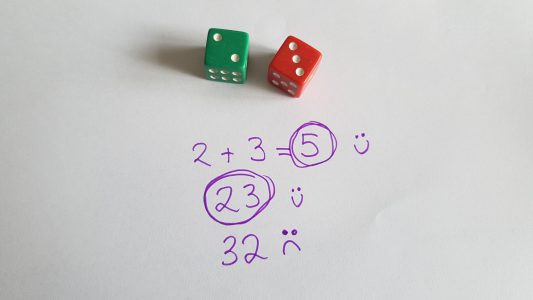
  • From the dice, construct 2 or perhaps 3 numbers. For example, if you throw a two and a three, you can make 5, 23 and 32 (3+2=5, two followed by three is 23 and three followed by two is 32)
  • Score one point for each prime number you have made (so this example scores one for the 5 and one for the 23, scoring two points in total).
  • If you need to use a calculator, then a Casio fx-83GT PLUS can tell you whether a number is prime. This is *not* cheating – students will soon start to recognise the primes they need, rather than having to check using the calculator!

The Winner Is:

The person who has the most points.

Things to discuss:

  • Why are two even numbers always such bad news? (even+even=even and the only even prime number is two)
  • Is it possible to score three points with one throw?
  • If there is a six in your throw, what happens?

This sample space diagram may help:

Sample Space Diagram for 2 Dice

1

2

3

4

5

6

1

(1,1)

(2,1)

(3,1)

(4,1)

(5,1)

(6,1)

2

(1,2)

(2,2)

(3,2)

(4,2)

(5,2)

(6,2)

3

(1,3)

(2,3)

(3,3)

(4,3)

(5,3)

(6,3)

4

(1,4)

(2,4)

(3,4)

(4,4)

(5,4)

(6,4)

5

(1,5)

(2,5)

(3,5)

(4,5)

(5,5)

(6,5)

6

(1,6)

(2,6)

(3,6)

(4,6)

(5,6)

(6,6)


Factorising Race

A game for 2 players. The winner is the player with most points at the end.

Starter (optional)

  • Play a game with the 13x table. This is almost completely unfamiliar and the kids will be intrigued. The KEY fact is that 7×13=91 because 91 is a terribly prime-looking number but it isn’t. Pupils who are confident with their other tables will, by learning this factorisation, have completed the full set of skills in factorising numbers under 100. 

Screen Shot 2014-05-13 at 16.50.05Introduction:

  • Make sure the players can factorise a number using their calculator. On the CASIO fx-83gt PLUS this is done by entering the number, pressing equals, SHIFT and ., ,,, (this has “FACT” written above it in yellow). The Prime Factor Form is displayed as the answer.

Each turn:

  • Roll 2 (or 3) dice, and choose which number to build. For example, a 5 and a 1 could be 15, 51 or 6. Factorise your chosen number. The score is the number of prime factors. eg 15 would score 2 for 3×5. 8 would score 3 because it is 2 cubed. 24 scores 4 because it is 2x2x2x3. 71 scores 1 because it is prime. ** You may need to explain the “Index Form” that the calculator displays. This is a very important notation anyway, which a lot of students misunderstand.

What Maths is learned:

  • To choose the best number, ideally the players have to mentally factorise both numbers. They will make repeated use of the standard divisibility tests (for 2, 3, 5 and 9) and probably invent a few more (this evening my pupil realised 357 and 217 must both be in the 7x table, just by looking at them.)
  • Once they know a number will divide, they have to actually DO it mentally. Practice makes perfect here!
  • A printed tables sheet may be a help.
  • In their enthusiasm to win they are stretching their own mental maths to the limit. If they don’t fully factorise both numbers, they may miss a high score!
  • A younger pupil may want to try all the possible numbers with the calculator – this is good practice anyway and reinforces the correct factorisations.
  • An enthusiastic player will start to memorise some of the factorisations – this is really helpful knowledge.

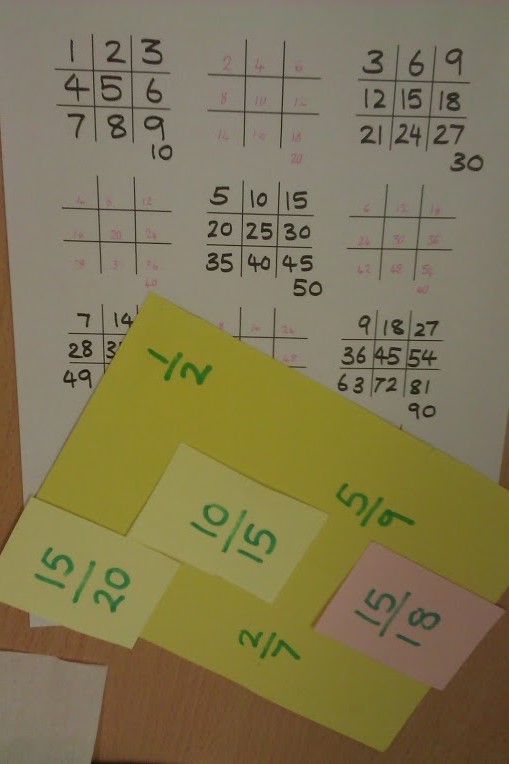
Cancelling Fractions. A game for 2-4 players.

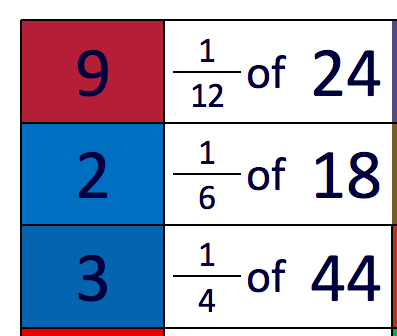
cancelling-fractions-game

You will need:

Slow Rounds:

  • Play like this while they get used to the game.
  • Give out a card, read the fraction, ask them if they have it on their board? (Probably they will say no)
  • Ask which table both those numbers are found in? For example, if the card says 15/20, those two numbers are both in the 5 times table. Ask what position the 15 is in (answer, 3). What position is the 20 in (answer, 4). So, 15/20 is WORTH 3/4.
  • The pupil covers 3/4 with the card.
  • Take in turns until someone has 4 covered (or all covered, depending what pace you want).

Fast Rounds:

  • Play like this once they are really confident and getting bored with the pace…
  • Hand out one card each, fast, they grab it and place it on their board. Commiserate if it is a duplicate that they don’t need “Oh no, not another one EQUIVALENT to 3/4!”. If they are pleased, celebrate “Great, you needed 2/9”. This gets the correct terminology bedded in, and also they see that fractions that are equivalent to each other generally LOOK really different.
  • If 2 pupils draw (covering 4 fractions) have a tie break round with another card. At this pace, it works well to aim to cover all the factions up.
  • If someone goes “bingo” check their board to make sure all the cards are in the right place.

Super Fast Round:

  • Give each pupil 5 cards and see if anyone can go bingo.

Bonus level thinking:

  • “You need one more card. What do you want to get?” Suppose it is 2/5. Point out they need a fraction made up of a “position 2, position 5” pair. Placing one finger in each position explains this nicely. It’s very gratifying if they get what they want straight away!
  • Get the pupils to highlight the odd numbers before they start. Think about whether a fraction’s numbers are odd or even, or one of each, and which tables they should be looking in. Being hazy about the importance of odds and evens is common amongst struggling mathematicians.