Chinese multiplication has been explained many times in many places on the Internet. This is a quick recap of the way I do it….
The kids I’ve taught, especially the more able ones, really like this way of multiplying numbers because it’s SOOOO easy to build up to very large numbers.
Within 20 minutes, a group of ambitious mathematicians has commandeered the class whiteboard and tried to do an ENORMOUS sum like 185936296722 x 15436796 and got an answer. This gives the teacher a problem. How can the sum be checked? Calculators and EXCEL will round the answer to only 10 or so significant figures, which is pretty hopeless for checking the work.
Here is a link to an EXCEL spreadsheet that will do these HUGE sums so you can check pupils’ (or your own) work.
The extra challenge that these interpid mathematicians give themselves, of course, is how to add together huge long lists of numbers. Here’s an example of one of the additions in the sum mentioned above:
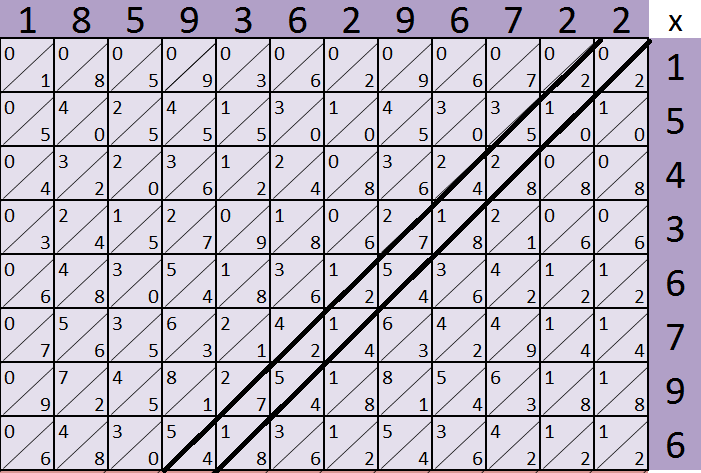
One of the additions needed to do the sum…
The student has to add 4,1,7,5,2,1,2,5,7,1,4,2,5,1,2 and 0. It’s tough to add all that without errors, so encourage them to look for TENS, and cross them out, “carrying” them into the next column…
They could make ten from the 4,1 and 5, then another from 7,2 and 1, and anotherfrom 1,4 and 5. Cross them out neatly and there’s not really much more to add! The nice thing is you can tackly any column you like, in any order, which is great for mathematicians who don’t know their right from their left! (except of course the TENS have to move left!).
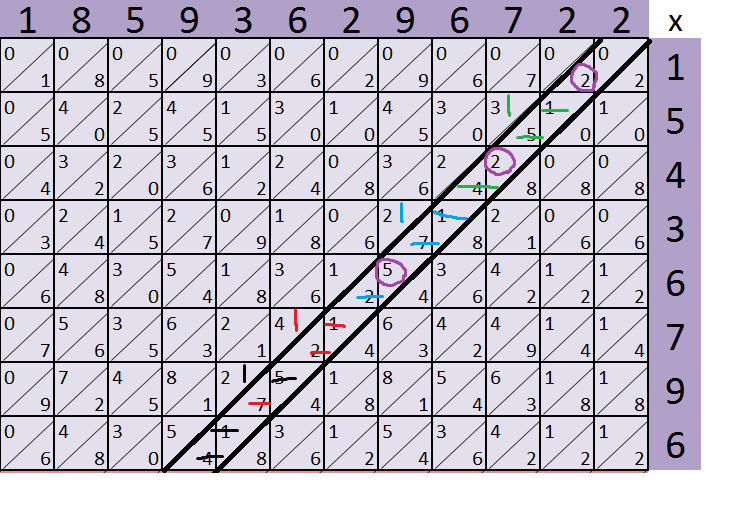
Most of the numbers made TENS! Each ten has been done in a distinct colour for clarity.

About half the adding done now…
Once this TEN-hunting is complete, the final pass is to add up any digits that are left.
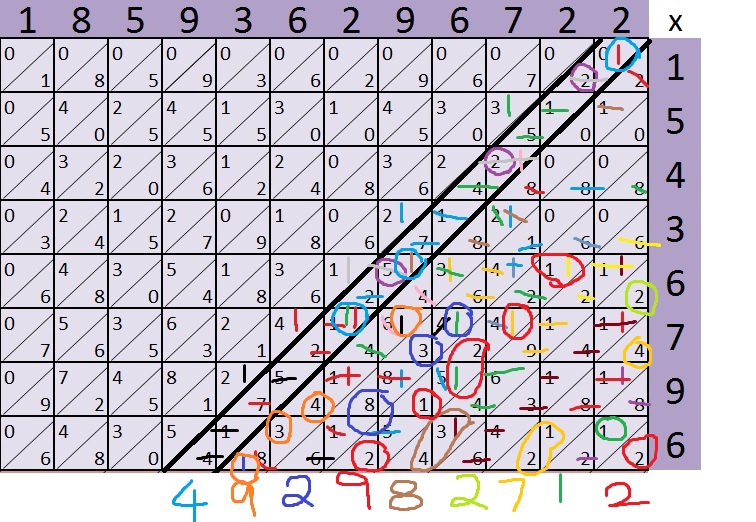
Most of the adding done now…

Completed! The answer!
Finally, some thoughts about the process of learning Chinese Multiplication:
- It’s great practice USING TABLES
- It’s great practice at ADDING long lists of numbers
- Pupils will normally self-differentiate and settle with the size of sum that suits them. For GCSE only a 2-digit by 3-digit sum is normally required (which seems a shame really!)
- They take time to learn how to draw the grids, and need to practice regularly. Sadly this pus some schools off teaching the method as “THE” method of multiplication. It is the most powerful, and handles decimals really easily too:

Decimal points in Chinese Multiplication

 Bellropespider